Computer skills from scratch·The first sitting·Lesson 10 of 180
WhatsApp is not email
 Ellis Dennis GrahamFounder, Cyber Elias Academy 2026-02-04 4 min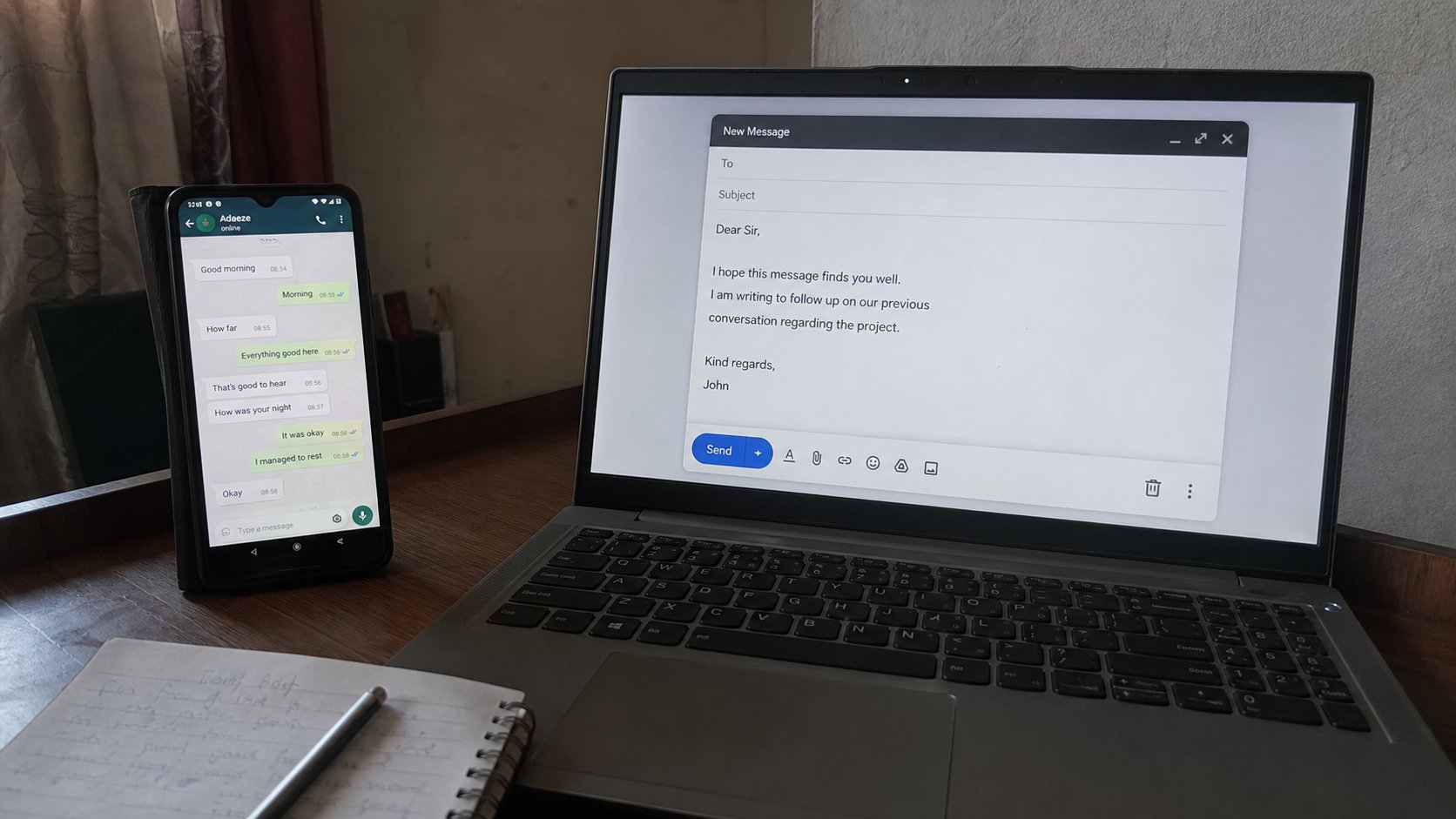
Chat is a tap on the shoulder. Email is a letter on a desk. Schools, banks, and workplaces still want the letter. Knowing which room you are in saves a week of silence.
In Nigeria, WhatsApp is how the day moves. A pastor, a landlord, a classmate, a mechanic — the green app is the tap on the shoulder. Email is quieter, older, and still the tray on an office desk. Mixing them up is how applications vanish, how a school never saw your receipt, how a job “did not get your CV.” This lesson is not against the phone. It is about knowing which room you are standing in.
Chat is for things that can live in a pocket: “I am five minutes late.” “Is the shop open?” “Here is the gate code.” The message sits in a thread that scrolls. Next week it is hard to find. Next year it is gone if the phone dies and was never backed up. Email is for things that must still make sense on a desk in October: an application, a fee receipt, a letter of request, a document someone else must file. The subject line is the label on the envelope. The attachment is the paper inside.
When the phone is the right room
Use WhatsApp when you already have the person's number, when the answer is short, and when both of you are in the habit of that chat. A class group that shares tomorrow's time. A “have you reached” to a sibling. A photograph of a blackboard, if the teacher asked for it there. Voice notes for people who listen faster than they read. That is the phone earning its keep.
Even then, a few manners transfer from letters. Say who you are if the number is new: “Good afternoon, this is Amaka from Computer Basics.” Do not send five fragments that could have been one message. Do not send a document as nine blurry photographs if you can send one PDF. Do not assume a blue tick means the person can act; it means the phone received a packet. People drive, teach, and sleep.
When only email will do
If an advertisement, a form, or a person with an office says “send it to this address,” they mean email. A WhatsApp to a number you found on Facebook is not the same tray. Admissions, banks, scholarships, job boards, and many lecturers still sort their work by subject line. Your carefully typed chat is invisible there. Use the letter: To, Subject, body, attachment, as the email lesson taught.

Sometimes you should do both, in that order. Email the receipt to the address on the form. Then send a short WhatsApp: “Good afternoon. I have emailed the fee receipt to accounts@…, subject March fees — Amaka Okoro.” The chat is a knock. The mail is the file. Do not reverse it — a knock with no file, then silence when they ask you to resend, because the photograph compressed into dust.
- Find one thing you must send this week: a receipt, a form, a short request.
- If you were given an email address, send it there with a real subject and the file attached, named clearly.
- If you were given only a phone number, send one WhatsApp that states who you are and what the file is, then the file, once.
- If you were given both, email first, then a two-line chat pointing at the subject. Do not send the same PDF five times in five places.
Files, groups, and what disappears
WhatsApp compresses photographs. A receipt that looked sharp on your screen can arrive as a grey soup. For anything a stranger must read — a passport page, a bank slip, a filled form — a PDF or an original document through email survives. If you must use chat, use Document, not Camera, so the file is not treated as a snapshot. Tap the paperclip, choose Document, find the file in the house you already learned.
Groups are rooms with many ears. A class group is not a private letter to the instructor. Do not post your BVN, your OTP, or a quarrel. Reply privately when the matter is one person's. Admin messages pinned at the top are the closest thing chat has to a subject line — read them before asking the question already answered.
Back up the phone if the chats matter. WhatsApp can save to Google Drive or iCloud; that is a setting, not a miracle. It still is not a filing cabinet. The academy will not hunt through your backup to find last term's receipt. Put work that must last in Documents, on email, on a USB, the way the files lesson said. Use the green app to live. Use the letter to remain.